
Web Analytics Manager Interview Questions You'll Face in 2026
You’ve built your skills, updated your resume, and landed an interview for a web analytics manager position. Now comes the hard part: actually impressing the interviewer.
Web analytics interviews test both your technical knowledge and your ability to think like a business person. Employers want someone who can use tools like Google Analytics but also someone who understands why the data matters.
This guide covers the most common web analytics manager interview questions for 2026, complete with example answers and tips for standing out. Whether it’s your first analytics interview or you’re moving up to management, this preparation will help you succeed.
What to Expect in a Web Analytics Interview
Most web analytics interviews include several stages:
Phone screening – Basic questions about your background and interest in the role
Technical interview – Questions about GA4, SQL, tools, and implementation
Case study or practical test – Real-world scenario where you analyze data or solve a problem
Behavioral interview – Questions about teamwork, communication, and past experiences
Final interview – Meeting with senior leadership or team members
Understanding this structure helps you prepare appropriately for each stage.
H2: General Background Questions
These questions assess your interest and overall fit for the role.
Step 2 - Master Essential Technical Skills
Technical skills are what get you hired. Here’s what you need to learn and in what order.
Tell me about your background in web analytics
What they’re really asking: Do you have relevant experience and can you communicate clearly?
How to answer:
- Briefly summarize your journey into analytics
- Highlight specific achievements or projects
- Connect your experience to their company’s needs
- Keep it under 2 minutes
Example answer: “I started working with web analytics three years ago as a marketing analyst at an e-commerce company. I taught myself Google Analytics to track our campaigns and became interested in how user behavior affects conversions. I took several certifications including GAIQ and learned SQL to dig deeper into our data. In my current role, I manage analytics for our entire website and mobile app, providing insights that helped increase conversion rate by 18% last year. I’m excited about this role because your focus on customer experience aligns perfectly with what I’m passionate about.”
Why do you want to work as a web analytics manager?
What they’re really asking: Are you genuinely interested in this field or just looking for any job?
How to answer:
- Share what you find interesting about analytics
- Mention the impact data-driven decisions can make
- Connect to the specific company and role
Example answer: “I love the detective work of web analytics. Finding patterns in data that explain why users behave certain ways and then seeing those insights drive real business improvements is incredibly satisfying. What excites me about moving into management is the opportunity to scale that impact by building analytics capabilities across an entire team. Your company’s growth trajectory means there’s a real opportunity to establish strong analytics practices that will guide decisions for years.”
What do you know about our company?
What they’re really asking: Did you actually research us or are you just applying everywhere?
How to answer:
- Show you understand their business model
- Mention something specific from their website or news
- Connect to their analytics needs
Example answer: “You’re a SaaS company focused on project management tools for remote teams. I noticed from your blog that you recently hit 50,000 users and are expanding into the enterprise market. That growth stage is exciting because analytics becomes crucial for understanding which features drive retention and where enterprise customers have different needs than smaller teams. I saw in your job posting that you’re looking to build better attribution models, which is something I’ve done extensively in my current role.”
Technical Questions About Google Analytics
GA4 is the foundation of most web analytics roles, so expect detailed questions.
Explain the difference between sessions and users in GA4
What they’re really asking: Do you understand basic GA4 concepts?
How to answer:
- Define both terms clearly
- Explain when each metric matters
- Give a practical example
Example answer: “A user is a unique individual who visits your website, identified by a unique ID stored in a cookie. A session is a period of activity by that user. One user can have multiple sessions over time. For example, if I visit your website on Monday, leave, and come back on Wednesday, that’s one user but two sessions. Users help you understand audience size, while sessions help you understand engagement frequency. If you see sessions growing faster than users, it means people are returning more often, which is usually positive.”
How would you set up conversion tracking for a new website?
What they’re really asking: Can you actually implement analytics, not just read reports?
How to answer:
- Walk through the process step by step
- Mention both GA4 and Tag Manager
- Show you understand business goals come first
Example answer: “First, I’d meet with stakeholders to understand what conversions matter for the business. Is it purchases, form submissions, downloads, or something else? Then I’d implement GA4 through Google Tag Manager for flexibility. I’d set up the base tracking code first and verify it’s working. Next, I’d configure conversion events based on those business goals. For an e-commerce site, that means purchase events with transaction details. For a lead generation site, form submissions. I’d also set up enhanced measurement for things like scroll depth and video engagement. Finally, I’d test everything thoroughly using Tag Assistant and debug mode before launching, and I’d document everything for future team members.”
What's the difference between GA4 and Universal Analytics?
What they’re really asking: Are you updated on current platforms or stuck in the past?
How to answer:
- Acknowledge Universal Analytics is sunset
- Highlight key GA4 improvements
- Show you’ve actually used GA4
Example answer: “Universal Analytics was the previous version that stopped processing data in 2023. GA4 is fundamentally different because it uses an event-based model instead of session-based. Everything in GA4 is an event, which gives much more flexibility. GA4 also handles cross-platform tracking better, combining web and app data. The reporting interface is completely different, with exploration reports replacing custom reports. GA4 has better privacy controls built in, which matters with regulations like GDPR. The machine learning features like predictive metrics are also much stronger. I’ve been working exclusively with GA4 for the past two years, so I’m very comfortable with how it differs from the old platform.”
How do you handle data sampling in GA4?
What they’re really asking: Do you understand GA4 limitations and workarounds?
How to answer:
- Explain what sampling is and why it happens
- Describe strategies to avoid or minimize it
- Show you know when it matters
Example answer: “Sampling happens in GA4 exploration reports when you query more than 10 million events. GA4 analyzes a subset of data and extrapolates, which can reduce accuracy. To minimize sampling, I narrow date ranges, use fewer dimensions, or apply filters to reduce the data volume. For mission-critical analysis that’s getting sampled, I export raw data to BigQuery where you can query the complete dataset without sampling. That said, for most business questions, a well-sampled dataset still provides reliable insights, so I evaluate whether the extra complexity of BigQuery is necessary.”
Learn more: Web Analytics Manager Skills You Need in 2026
SQL and Data Analysis Questions
SQL skills separate basic analysts from advanced ones.
Write a SQL query to find the top 10 pages by page views
What they’re really asking: Can you actually write SQL or just talk about it?
How to answer:
- Write the query clearly
- Explain what each part does
- Show you understand the data structure
Example answer: “Here’s the query I’d write:
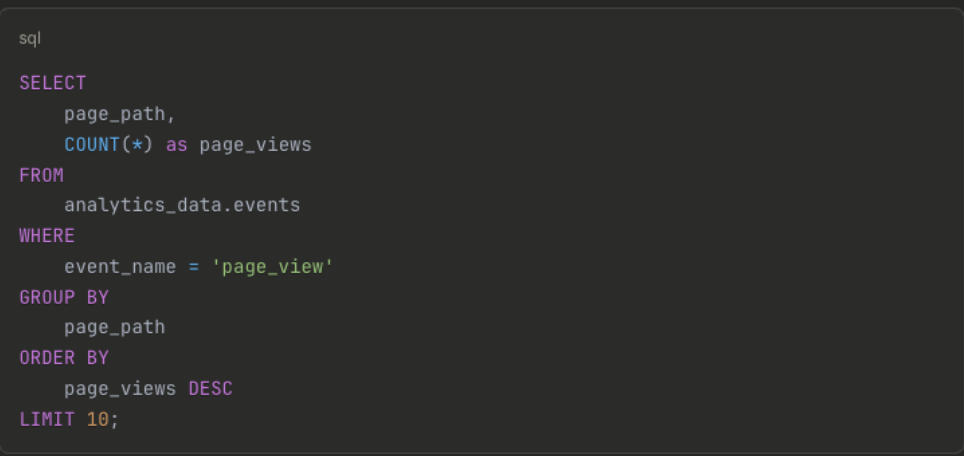
This selects the page path and counts how many times it appears in the events table, filtering only for page view events. GROUP BY combines all instances of each page, ORDER BY sorts from highest to lowest, and LIMIT returns just the top 10. I’m assuming GA4 data exported to BigQuery here, where page_view is an event.”
How would you calculate conversion rate using SQL?
What they’re really asking: Can you handle calculations and understand business metrics?
How to answer:
- Define conversion rate clearly
- Write the query
- Explain the logic
Example answer: “Conversion rate is the percentage of sessions or users who complete a desired action. Here’s how I’d calculate it:
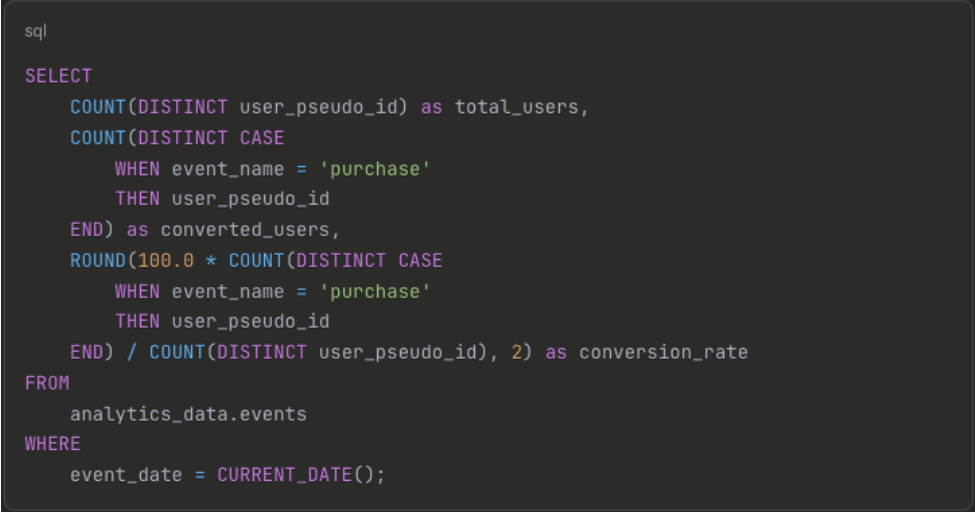
This counts total unique users and unique users who made a purchase, then calculates the percentage. The CASE statement counts only users who had a purchase event. Multiplying by 100.0 converts to percentage, and ROUND makes it readable.”
Data Visualization and Reporting Questions
Presenting data clearly is crucial for web analytics managers.
How do you decide which visualization to use?
What they’re really asking: Do you understand effective data presentation?
How to answer:
- Show you match visualization type to data type
- Mention specific chart types
- Emphasize clarity over complexity
Example answer: “The visualization should match what you’re trying to show. For trends over time, line charts work best. For comparing categories, bar charts are clearer than pie charts. For showing part-to-whole relationships, stacked bars or tree maps work well. For correlations, scatter plots reveal relationships. I avoid 3D charts and unnecessary decoration because they reduce clarity. The goal is always to make the insight immediately obvious. Before creating any dashboard, I ask: What question is this answering? Then I choose the simplest visualization that answers it clearly.”
Walk me through how you'd build a dashboard for our executive team
What they’re really asking: Can you understand stakeholder needs and deliver executive-level insights?
How to answer:
- Start with understanding their questions
- Focus on outcomes, not activity
- Keep it simple and actionable
Example answer: “First, I’d meet with executives to understand what questions they need answered. They typically don’t care about bounce rates or time on page. They want to know: Are we growing? Is that growth profitable? Where should we invest? So I’d focus the dashboard on business outcomes. For an e-commerce company, that’s revenue, conversion rate, average order value, and customer acquisition cost. I’d show trends over time with comparison to previous periods and goals. I’d include one or two levels of detail they can click into, but keep the top level simple and focused on what they can act on. I’d design it so it loads quickly and they can access it on mobile. Finally, I’d include brief annotations explaining any major changes.”
Problem-Solving and Analytical Thinking Questions
These questions test how you approach real analytics challenges.
Website conversion rate dropped 20% last week. How would you investigate?
What they’re really asking: Can you diagnose problems systematically?
How to answer:
- Show a logical investigation process
- Consider multiple potential causes
- Demonstrate technical and business thinking
Example answer: “I’d start by verifying the data is correct. Was there a tracking implementation change? Check Tag Manager and GA4 to confirm everything’s still firing properly. Next, I’d segment the drop. Is it affecting all traffic sources or just one channel? All devices or just mobile? All products or specific ones? This narrows down causes. I’d check if traffic volume changed – sometimes conversion rate drops because traffic quality decreased, not because the site changed. I’d review any site changes deployed that week – new code, design updates, checkout flow modifications. I’d look at where in the funnel people are dropping off. Did the problem start at product pages or checkout? I’d also check if competitors launched campaigns or if there’s seasonality we’re not accounting for. Once I identify the likely cause through this process, I’d recommend specific fixes and track whether they resolve the issue.”
How would you measure the success of a new website feature?
What they’re really asking: Do you understand how to design analytics for product development?
How to answer:
- Define success criteria first
- Mention both quantitative and qualitative methods
- Show you understand A/B testing
Example answer: “First, I’d clarify with the product team what success means. Is it increased engagement, faster task completion, or higher conversion? Then I’d set up tracking before launch. I’d implement event tracking for interactions with the new feature and make sure we can compare user behavior before and after. Ideally, I’d recommend an A/B test where some users see the new feature and others don’t, so we have a clean comparison. I’d measure both direct metrics like feature usage and indirect metrics like overall conversion rate and retention. I’d also look at qualitative feedback through user surveys or support tickets. After a statistically significant period, typically 2-4 weeks depending on traffic, I’d analyze the results and make a recommendation about whether to keep, modify, or remove the feature.”
How do you prioritize when you have multiple analytics requests?
What they’re really asking: Can you manage your time and understand business priorities?
How to answer:
- Show you consider business impact
- Mention communication with stakeholders
- Demonstrate systematic thinking
Example answer: “I prioritize based on business impact and urgency. Requests that affect revenue or major business decisions go first. For example, analyzing a conversion drop affecting sales takes priority over a nice-to-have report about blog traffic. I also consider effort required. If something takes 15 minutes and unblocks another team, I’ll do it quickly even if it’s not highest impact. I communicate timelines clearly. When I get a request, I confirm the deadline and business context. If I can’t meet it, I say so immediately and propose an alternative. I also batch similar requests. If three people need reports from the same data source, I handle them together. Finally, I reserve time for proactive analysis. Not everything should be reactive. Some of my most valuable work comes from analysis nobody requested but that reveals important insights.”
Communication and Teamwork Questions
Analytics managers need strong soft skills.
Describe a time you had to explain technical concepts to non-technical stakeholders
What they’re really asking: Can you communicate effectively across skill levels?
How to answer:
- Use a specific example
- Show you adapted your language
- Emphasize the outcome
Example answer: “At my previous company, I needed to explain to our VP of Marketing why our attribution model was giving credit to channels she didn’t think deserved it. She was frustrated that email was getting more credit than paid search. Instead of diving into technical attribution methodology, I used an analogy. I explained it like a relay race where each runner contributes to the finish. The last runner crosses the line, but they only get there because of earlier runners. Similarly, a customer might convert after clicking an email, but they discovered us through paid search. I showed her visual examples of actual customer journeys to make it concrete. This shifted the conversation from skepticism to curiosity. She understood why we needed to look at the full journey, not just the last click, and she became a champion for better attribution analysis.”
Tell me about a time you disagreed with a colleague about how to interpret data
What they’re really asking: Can you handle disagreement professionally?
How to answer:
- Show respect for different viewpoints
- Demonstrate problem-solving
- Focus on reaching the right conclusion, not winning
Example answer: “Our product manager and I disagreed about whether a feature was succeeding. He looked at increased usage and called it a win. I saw that overall conversion rate had actually dropped slightly since launch. Instead of arguing, I suggested we dig deeper together. We discovered that power users loved the feature and used it heavily, but new users found it confusing and were abandoning earlier in the funnel. Both perspectives were valid but incomplete. This led to a better solution: we made the feature opt-in for new users but default for returning users. Usage stayed high among engaged users, and conversion rate for new users recovered. The disagreement actually led to a better outcome because we challenged each other’s assumptions constructively.”
Management and Leadership Questions
If you’re interviewing for a management role, expect these questions.
How would you build an analytics team from scratch?
What they’re really asking: Do you understand team structure and hiring?
How to answer:
- Show you’d assess needs first
- Describe the roles you’d prioritize
- Mention building culture and processes
Example answer: “I’d start by understanding the company’s analytics maturity and needs. What questions do teams need answered? What tools are already in place? Based on that, I’d hire in stages. First hire would likely be a strong generalist who can handle GA4, basic SQL, and reporting. This person provides immediate value while I assess longer-term needs. Second hire depends on gaps. If we’re lacking technical depth, I’d bring in someone strong in SQL and data engineering. If we’re weak in data visualization, I’d prioritize that. I’d aim for a mix of skills, seniority, and perspectives. As the team grows, I’d establish clear processes for handling requests, documenting analyses, and sharing knowledge. I’d create a culture where we’re not just answering questions but proactively finding insights. Finally, I’d invest in tools and training so the team continues developing.”
How do you help team members grow professionally?
What they’re really asking: Are you an actual leader who develops people?
How to answer:
- Show you care about individual growth
- Mention specific development approaches
- Connect to business needs
Example answer: “I believe in personalized development plans because everyone has different goals and strengths. In my one-on-ones, I ask about career aspirations. Does someone want to go deep technically or move toward management? Based on that, I provide opportunities that stretch them appropriately. For someone learning SQL, I might assign a project slightly beyond their current ability but offer support. I create space for learning through conference attendance, online courses, and time to explore new tools. I also give feedback regularly, both positive reinforcement and constructive guidance. When someone does excellent work, I make sure leadership knows about it. Career growth isn’t just my job as a manager, it’s how I build a stronger team that delivers more value to the company.”
Behavioral Interview Questions Using STAR Method
Use the STAR method for behavioral questions: Situation, Task, Action, Result.
Tell me about your biggest analytics win
Example using STAR:
Situation: “At my previous e-commerce company, mobile conversion rate was 40% lower than desktop, costing us an estimated $500K in annual revenue.”
Task: “My task was to identify why mobile users weren’t converting and recommend fixes.”
Action: “I analyzed the mobile user journey in GA4 and found that 60% of users abandoned at the shipping information page. I used session recordings and found the form was nearly impossible to use on small screens. I worked with our design team to create a mobile-optimized checkout flow and we A/B tested it.”
Result: “The new mobile checkout increased mobile conversion rate by 35% over three months, generating an additional $400K in revenue that year. The success led to a company-wide mobile-first design approach.”
Describe a time you made a mistake and how you handled it
Example using STAR:
Situation: “I was building a dashboard for our executive team and accidentally used filtered data without realizing it.”
Task: “The executives were making budget decisions based on my incorrect numbers.”
Action: “As soon as I discovered the error, I immediately informed my manager and sent a correction to everyone who had seen the dashboard. I explained exactly what went wrong and provided the correct data with clear explanations of the difference. I also implemented a peer review process for all executive-facing reports to prevent similar errors.”
Result: “While embarrassing, the executives appreciated my immediate transparency. The peer review process caught several potential issues over the following months. The incident taught me the importance of data quality checks and honest communication.”
Questions to Ask the Interviewer
Always prepare questions to ask. It shows genuine interest and helps you evaluate if the role is right.
Good questions about the role:
- What would success look like in this role after six months?
- What analytics tools and platforms does the team currently use?
- How does analytics influence decision-making today?
- What’s the biggest analytics challenge the company faces?
Good questions about the team:
- How big is the analytics team?
- Who would I work most closely with?
- How does the analytics team collaborate with product, marketing, and engineering?
Good questions about growth:
- What opportunities exist for professional development?
- How has this role evolved over the past year?
- What’s the typical career path for someone in this position?
Good questions about culture:
- How would you describe the team culture?
- What do you enjoy most about working here?
- How does the company support work-life balance?
Avoid asking:
- Questions easily answered by looking at their website
- Salary questions in early interviews (wait for offer stage)
- Negative questions about problems or conflicts
Related: Web Analytics Manager Salary in 2026
How to Prepare for Your Interview
Strong preparation makes the difference between okay and excellent interviews.
One week before:
- Research the company thoroughly
- Review their website and note analytics opportunities
- Practice answers to common questions
- Prepare your own questions
- Review GA4, SQL, and tools documentation
Day before:
- Review your resume and be ready to discuss everything on it
- Prepare specific examples of your work
- Get your materials ready (notepad, pen, portfolio)
- Test your technology if it’s a video interview
- Get good sleep
Day of interview:
- Arrive or log in 10 minutes early
- Bring multiple copies of your resume
- Bring a notepad for taking notes
- Dress professionally and appropriately
- Turn off your phone completely
During the interview:
- Listen carefully before answering
- Ask for clarification if needed
- Use specific examples from your experience
- Show enthusiasm for the role
- Take brief notes
- Watch your time and be concise
After the interview:
- Send thank you emails within 24 hours
- Reference specific discussion points
- Reiterate your interest and fit
- Provide any additional information they requested
Common Interview Mistakes to Avoid
Don’t undermine your preparation with these errors:
Being too technical – Remember your interviewer might not be a technical expert. Explain clearly.
Only talking about tools – Tools matter, but business impact matters more. Connect your technical skills to results.
Badmouthing previous employers – Even if your last job was terrible, stay professional and focus on what you learned.
Not asking questions – This makes you seem uninterested. Always prepare questions.
Failing to prepare examples – Vague answers don’t impress. Have specific stories ready.
Lying about your skills – If you don’t know something, say so. Interviewers can tell when you’re faking.
Not following up – A thank you email is expected. Not sending one suggests poor communication skills.
Final Thoughts
Web analytics interviews can feel overwhelming, but preparation makes them manageable. The companies interviewing you need your skills as much as you need the job.
Focus on demonstrating three things:
- Technical competence – You know the tools and can use them effectively
- Business thinking – You understand how data drives decisions
- Communication skills – You can explain complex ideas clearly
Practice your answers out loud. It feels awkward but makes a huge difference. Have a friend or family member ask you questions so you get comfortable speaking about your experience.
Remember that interviews are two-way. While they’re evaluating you, you’re also evaluating whether this role and company are right for your career.
Ready to build the skills you need? Web Analytics Manager Skills You Need in 2026
Wondering about salary expectations? Web Analytics Manager Salary in 2026
Starting your analytics career? How to Become a Web Analytics Manager in 2026